
Universität Salzburg Student Looks to the Past to Shape Media Futures at the 20th Salzburg Academy on Media and Global Change
A University of Salzburg student and two faculty members were among more than 75 participants at the 20th in-person convening of the Salzburg Academy on Media and Global Change
From 20th July to 4th August 2026, over 75 people from across the world gathered at Schloss Leopoldskron for the Salzburg Academy on Media and Global Change. The 48 session participants included undergraduate students, graduate students, and early- to mid-career media professionals. They were joined by 30 faculty members, including visiting guests, speakers, experts, and scholars. All together, they represented Hong Kong, the US, India, Argentina, Thailand, Spain, the UK, Mexico, Qatar, Lebanon, China, Brazil, Portugal, Austria, and many more countries.
This truly international group gathered to explore the topic, “Created Histories, Creative Tomorrows: Distinct Moments that Shape Media Futures,” which invited participants to conceive and explore global media models that nurture a healthy society, whilst being sustainable for media practitioners.
The University of Salzburg at the Academy
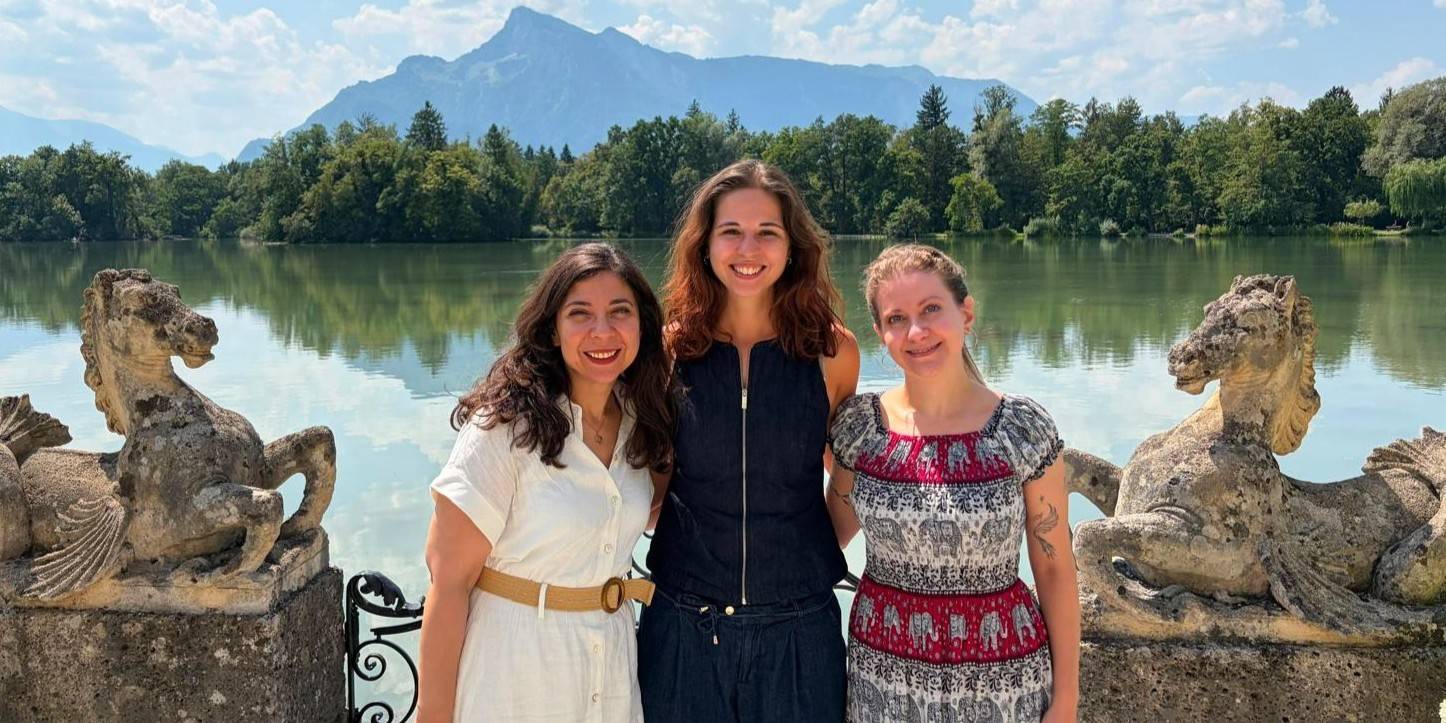
2026 marked the third year of the partnership between the Public Spheres and Inequalities Division at the University of Salzburg and Salzburg Global. Through this partnership, Anna Strobel, a Communication Studies student, was awarded a scholarship to participate in the Academy. Prof. Dr. Hanan Badr, Head of the division, and Thawab Hilal, Senior Scientist in the same division, served as faculty members at the Academy.
This year’s session celebrated the 20th anniversary of the Salzburg Academy on Media and Global Change, which is notably one of Salzburg Global’s longest-running programs. For two decades, the program has brought together emerging media leaders to build lasting networks, collaborate on solutions to social challenges, and develop the skills needed to shape a more informed and engaged future. The 2026 session stands as both a reflection and a renewal – a moment to honor the Academy’s long-standing mission to cultivate media leaders who can think critically, act creatively, and communicate responsibly in a fractured world.
Program Director and faculty chair, Paul Mihailidis, echoed the Academy’s mission of fostering resilience and purpose within its participants.
“In a world that marches towards cruelty, this project, for two decades, has explored how we can understand and build media that creates reservoirs of goodwill; that are intentional in their pursuit of inclusive and just futures, and that embrace a radiance that conspires towards joy, connection, and compassion.”
Workshops, Excursions, and the Shumow Symposium
Participants attended lectures taught by professors from institutions around the globe, workshops led by visiting experts and excursions to the UNESCO World Heritage site Gosausee and the Dokumentation Obersalzberg Museum.
Participants also attended the third annual Shumow Symposium, hosted by the University of Salzburg at the Unipark Nonntal campus on 31st July 2026. This day of lectures, film screenings, and dialogue was held in memory of late faculty member Moses Shumow.
Six Visions for Digital Media in 2046
The international cohort collaborated in small groups throughout the duration of the two-week-long session. In these groups, participants conceptualized how society might interact with digital media 20 years into the future, and how these future digital mediums could look and feel. Their final concepts were presented to peers and faculty on the final day of the Media Academy. The six concepts include:
- Connectus Sphere: A community-owned, location-based discovery tool for helping people find and host in-person gatherings around shared media experiences.
- Platform G: One social media platform, for everything and everyone, designed to prioritize authentic and diverse content without algorithmic engagement.
- Hayven: A decentralized, open-source platform that gives users democratic control over their algorithms through AI-assisted curation, authenticity filters, and privacy boundaries.
- Community Tapestry: A “participatory form of civic media” where users gather to explore each other’s creativity and expression, serving as an antidote to loneliness, apathy, and toxic online environments.
- Timeless Magazine and The Thinking Cap: A community-focused lifestyle magazine that is accessible through “The Thinking Cap,” a single-purpose, reading headset that utilizes interactive holographic projections to improve tactility and restore attention spans.
- Deform: A language used by humans to protest mass AI use and digital censorship by organizing protests and signaling AI-generated content.
Participants’ full media outputs and other materials are shared in the cohort’s digital publication, “Back to the Future” on the online platform Medium.
International Collaboration and Research
For the University of Salzburg, the partnership builds long-lasting connections with scholars and media practitioners from around the world, makes the Division’s research on exile journalism and inequalities in public spheres visible to an international audience, and contributes to current debates on how media futures can be made more just.
The Salzburg Academy on Media and Global Change is an annual program that convenes emerging leaders in media fields to build networks for positive change. If you would like to find out more, please email psi_kowi@plus.ac.at.